Interview Jorgen
"If you're part of the problem, you should be part of the solution"
Nikhef's director on energy budgets, future-proofing physics, and planting a flag
Imagine having ten million euros to improve a particle accelerator. The obvious move: push performance from 70% to 80%. That's what physics institutes do. That's what the field rewards.
Jorgen made a different call. Keep performance where it is: and spend the money making the machine use less energy. "Ten years ago, twenty years ago, you'd have said: but why are you doing this?" He smiles. "Well, because if we want to keep building particle accelerators in the future, and we want society to let us build them, I'm quite sure society will say: yes, you can do that, but you'll have to do it within a certain energy budget."
Jorgen is the director of Nikhef, the national institute for subatomic physics. He is methodical, optimistic, and has the habit of returning to the same phrase when he wants to make a point land.
Catharina: What does sustainability mean to you?
Jorgen: Sustainability is an important but also very broad concept. For me it means making ourselves resilient for the future, in a way where that future looks at least as good as where we stand today. That can mean many things: drinkable water, energy, a healthy ecosystem, nature, healthy people. So sustainability is a very broad concept for me.
If we zoom into what it can mean within Nikhef, it's also broad. We can say: we'll make sure everyone is healthy, we'll exercise, eat well and that's one important dimension. But with the concrete actions we take in our core research, we also affect our CO2 footprint and our energy consumption. We all know it's better to emit as little CO2 as possible, ideally none. We all know that when we use energy, we should use it as efficiently as possible. And those two things are closely linked to what we actually do. Big science. Large instruments. Developing, building, using those instruments. They have a carbon footprint, they have significant energy consumption. Think about large accelerators, think about certain gases we've used in the past. There we must, and can, take action.
My motto is: if you're part of the problem, you should be part of the solution. And we can be part of the solution. We do research, we develop things to come out better in the future. But we have to do that in a way that is sustainable: so that we remain viable for the future, and so that society in ten, twenty years will still allow us to do that same research. Because society, even now, will say: you use a lot of energy. Make sure that if you use that energy, you recover it, you use it optimally, you use as little as possible. We can work on that.
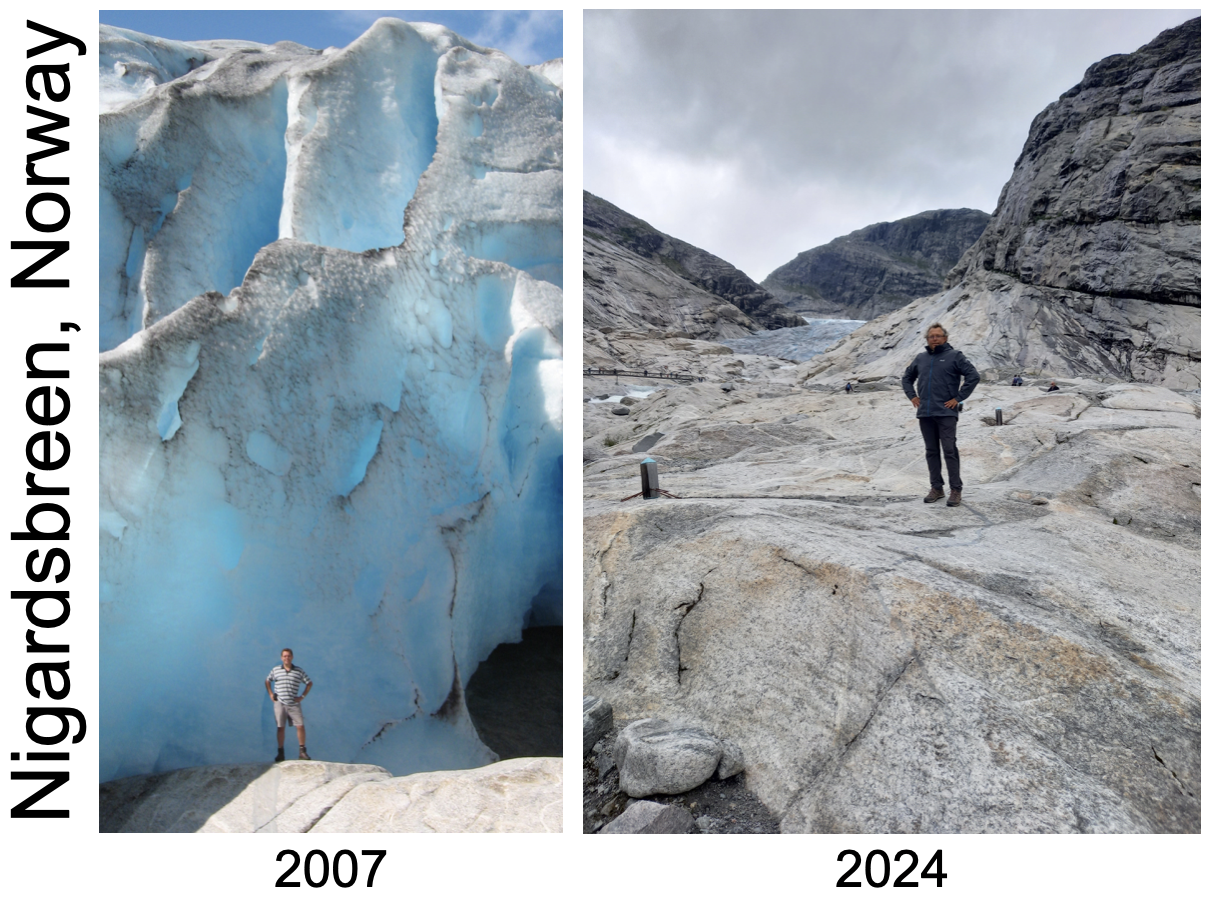
The same location in Norway, photographed in 2007 and again in 2024. For Jorgen, it is a tangible reminder that the changes we often observe in graphs and datasets are also unfolding in the landscapes around us.
Catharina: What gives you a sense of impact on a daily basis?
Jorgen: I think if we're serious about sustainability; resilience toward the future, we first need to create a mindset. Each of us, together, needs to create a mindset that we can actually work on this. If you're part of the problem, you should be part of the solution. That's not an obvious mindset, because sustainability is a very broad concept with many dimensions, and sometimes certain dimensions get forgotten.
People think quickly of: I drive to work, I should drive less. That's obvious, and it's right. But there are many other aspects we all need to look at together. For every step we take, we should have a moment of reflection; just like we reflect on cost, on the performance of our research and instruments. We should also ask: are we being sustainable? Will we still be able to do this in the future, in a healthy ecosystem, in a way that's still permitted?
Catharina: Does that give you energy?
Jorgen: It does, actually. I'm currently running a large European project on the sustainability of particle accelerators. We've clearly understood that if we build new large particle accelerators, we sometimes need a large fraction of the power of a nuclear reactor to operate them. That's not the reality we can count on. If in twenty years we go to society and say we need one or two nuclear reactors to run our experiment, I immediately know what the answer will be. That's not sustainable. That's not having the same possibilities in the future that we have today.
So: you're part of the problem, you should be part of the solution. Where does our solution lie? Developing technologies for those accelerators that use energy more efficiently. Or recovering energy within the system. We don't have influence over optimising nuclear reactors, or over how energy networks are rolled out, that's not our expertise. Our expertise is in designing particle accelerators and the technologies around them. That's what we're building: a European project, with many partners, to develop that technology.
And the impact could be phenomenal. That's the choice we're making together with those partners: we're prioritising the development of technology that says, first and foremost, we're going to use less energy. Less focus on improving performance, more focus on achieving the same performance with less energy. That's quite a shift. Normally a research institution says: I have ten million euros, let's take performance from 70% to 80%. Excellent, let's do it. Now we're saying: I actually want to stay at 70%, but I want to do it with less energy consumption. And I'm putting ten million euros behind that.
That's a mindset shift. Ten or twenty years ago, people would have asked why. But if we want to build particle accelerators in the future and ask society's permission to build and use them, society will tell us: yes, you may, but within a certain energy budget. We need to be ready for that.
Catharina: Does that kind of urgency create resistance? Some people experience sustainability as things being taken away.
Jorgen: That's a very important point. If performance and precision are the only parameters in our DNA (the only things that count) then yes, you'll get resistance. But if your DNA also includes: wait, it's not just about accuracy and cost, it's also about whether we'll still be able to do this in the future, then the question won't come up anymore. You'll naturally say: a new technology development is successful if it meets at least one of those parameters, or improves on them. But it has to be in our DNA.
Now, in most cases, investing in more sustainable technologies will also end up improving performance. If you're using one megawatt for a certain particle accelerator, and you're told: that megawatt is your budget, stay within it, and you develop technology that uses ten times less energy, then within that same envelope, you can be ten times more performant. Ten times more data, ten times more analysis. So there's something in it for performance too.
Today that's still often the driver, I think. Staying within existing energy envelopes and improving performance within them. But look at global energy consumption, it's grown enormously over the last fifty years and it keeps growing. If we want to go fully green or carbon-free, a part of that can become carbon-free, but not everything. Eventually, for large experiments, the energy envelope you're working within will have to shrink. That urgency isn't here yet. You don't feel it yet. The status quo of energy consumption is still what's on most people's minds — CO2 is different, but for raw energy use, the urgency hasn't arrived. So right now we still have a window — a window of opportunity to get this into the DNA of researchers. And that's the moment to do it.
Catharina: What about computing? Software? That's where a lot of energy is used.
Jorgen: It's been a while since I was launching programmes on large clusters myself. But what I remember from that time: you press a button, somewhere else your software starts running, doing many things, and three days later it comes back and says, the answer is seven. And you think: oh. I made a mistake... Three more days.
In the past, no one stopped to think about that. Just press the button. Today I think people stop to think a little more, but not fully. Because the person pressing that button, the software user launching an analysis on a computing cluster, is not really informed about what's happening behind that screen. Where is the software going? What is it doing there? What is the CO2, what is the energy footprint? In some countries the energy footprint and the CO2 footprint are strongly linked. In other countries, France, for example, less so, because of nuclear power. But that awareness simply needs to come.
And there too, if you develop your software to be more efficient, you can stay within your energy footprint and improve your results. But if at some point you're told: do it with half the energy, you need to be ready for that. We have the opportunity here to give our researchers something: the awareness that your software leaves a CO2 and energy footprint, what is that footprint? But also the training: how do you improve it? How can you be part of the solution?
A researcher who can programme sustainably, and efficiently, is an absolute asset for the future. I don't doubt that for a second. That awareness isn't fully in our DNA yet. We need to feed it.
Catharina: If you look five or ten years ahead, and sustainability is fully integrated into Nikhef, what does that look like? How is it different from today?
Jorgen: I don't think I should isolate one element from the others. If I'm planting a big flag in the future, five years, ten years from now, it has to be a flag where all those sustainability elements, all those resilience elements, sit together in the mindset.
The person who says: yes, I'll make sure I don't use a certain non-sustainable gas, but everything else I'll just do as always, that has to change. I think everyone needs to understand that sustainability is a connection between very many of the actions we take. And that in all of those directions, we need a moment of reflection. What are we doing? Why are we doing it? What is the impact — in the broadest sense? And can I contribute something toward a solution in my own actions? Everyone can help create a sustainable world. And at a certain point, within Nikhef, everyone will need to help create that sustainable world. On two levels: making sure your own footprint in the broadest sense is minimised, and also helping develop techniques and technologies, across the full spectrum of our research, and perhaps beyond in applications — to reduce the overall footprint as well.
But it will be a bit here, a bit there, a bit everywhere. We'd be wrong to say: let's only focus on the energy consumption of a computing centre. It has to be general. And if it's general, embedded in our mindset, it becomes much easier for everyone to work together. Because one person will approach it through food, another through the environment, another through energy. It's precisely the combination of those things that makes us strong. We can learn from each other, how each of us in our own area can do things differently, more sustainably.
That's the big flag I'd like to plant: to have that collective story in our DNA. The awareness first, but then also the understanding that we're all in that story together. It's not an us-and-them story. It's our story.
Catharina: Is there something you'd like to give everyone during this Sustainability Week?
Jorgen: A sustainability week is where we plant the seeds, giving everyone the awareness that sustainability is a very broad concept, where we can all work together, coherently, toward a sustainable future. And this isn't the end of the journey. It's the beginning of a very long one, that we take step by step, together.