Interview Jacco
"You can rationalise it, but you shouldn't waste it"
A researcher on Star Trek optimism, simulation jobs, and why teaching matters more than physics
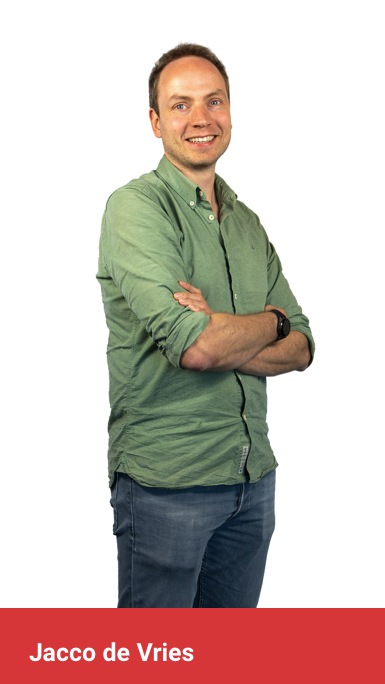
He takes the train to Spain for holiday. Two days, he says. Pretty long. Pretty expensive. He has no car. He and his partner eat mostly vegetarian, their mortgage is with Triodos instead of ING, and he cycles and takes the train to work. "For what you can do as an individual, we try to do a bit of that."
He says this not to impress anyone. He says it almost apologetically, as if it needs contextualising. Because what comes next is equally honest: at work, he runs simulation jobs on computing clusters that cost a frankly insane number of CPU cycles. And he's more or less made his peace with that.
Catharina: What does sustainability mean to you; privately and at work?
Jacco: Something you can't think away from the modern Western world, at least. It's a modern mindset I think we all need to believe in. We have to believe in it. It's a finite world. There are no infinite resources. If you have it as good as we do in the Netherlands, then you have to think about it. For the goodness of the world. I feel it as an obligation, kind of.
Professionally I feel the same way. But I also have the sense that some things just use electricity. Running an LHC job is obviously not great for the environment. But it's a means to an end. You want to gain knowledge from it. So, what does it cost? You have to minimise that. But you also have to accept that it just costs a gigantic amount of CO2. That's the price we pay to do the research.
So I can rationalise it. I don't feel terrible about it. But you shouldn't waste it either. If you make a small mistake in a script and it has to run again, you should learn yourself beforehand to just actually check it properly, or send a test job first before you submit the whole thing. Otherwise it's genuinely a waste.
Catharina: Where do you feel you make a positive impact with the work you do?
Jacco: Okay. I mean, the research we do is a very small piece of a very small niche area. You're working on something for years and you've just made a tiny bit of a tiny corner of things slightly better. It can be challenging to see what the direct impact of that research is on society. Where a positive contribution is a lot more clear, is when I teach students. I didn't see it that way at first, but now that I've been doing it for a few years, I increasingly feel that I really make a difference for people. That I can motivate them. Give them some technical grounding. Spark an interest in science.
That, I think, has much more impact than the research itself. The research is almost an excuse to be able to train people. You need to stay active in the field to be able to pass it on.
Catharina: You also mentioned keeping knowledge alive as something important.
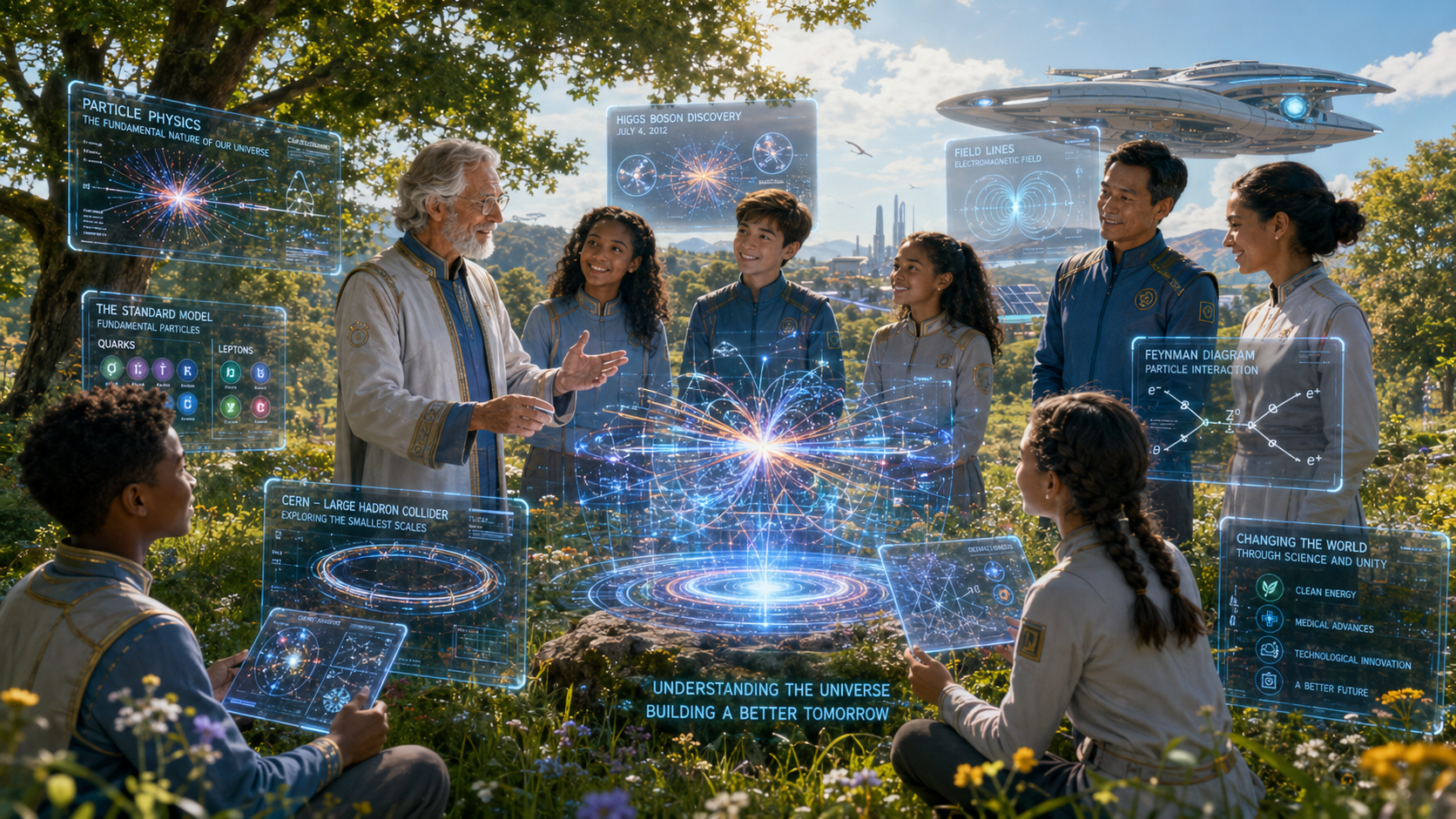
Jacco: Yes. If we stopped building the next accelerator, stopped the LHC, then people are no longer being paid to actively keep that knowledge about the Standard Model alive. And then it slowly fades. And at some point humanity doesn't really know anymore, in an active way, how things work at that small scale; quarks, forces, all of that.
It's like the race to the moon. So much knowledge about rockets was built up, and then it completely faded, and when they tried again they had to reinvent enormous amounts of it.
Catharina: What questions do you ask yourself about the future?
Jacco: I'm generally pretty positive. It might sound a bit nerdy, but I grew up watching Star Trek. In that world there was world peace, partly because at some point aliens turned out to exist, and that became a kind of excuse for humanity to unify. I've always held that image: that the technological future will make sure that people end up living in peace and everything keeps getting better.
That's my bias, I think. And I do still see it; technologically things keep getting better, hunger is improving, but some things are also getting worse. Because if the Gulf Stream tips, we're all in trouble, climate migrants everywhere, war everywhere. So I don't really know anymore whether the future is genuinely good. I have confidence it'll be okay. But it's not a given. It requires everyone contributing a little bit in the positive direction. You can vote, you can have a small positive influence on your local environment. That's what you can do as a person.
Catharina: Sustainability can sometimes come across as negative; things being taken away. How do you make that conversation more open?
Jacco: I don't know if I have the authority to answer that. But I think what often helps is trying to make it people's own problem. That people feel it aligns with their own sense of what positive impact they want to have. That it's their own interest, not because Nikhef or NWO says so. That people feel they themselves want to do something about the climate. Motivated from within.
Then you can pretend it wasn't your idea. But at least they feel it was their idea. How you do that without doing inception on people, I don't know. But educating students, making them aware, so they feel it as something they care about themselves. That seems like the right direction.
Catharina: Do you see overlap between the research we do here and the big societal challenges?
Jacco: The first thought I have is that it's difficult, because we do fundamental research; not directly applicable in a societal sense. But what we do is spark interest in people, who then go into technical fields. And we can lead by example as a research institute; using server heat to warm the apartments across the street, trying to be climate-neutral by 2035.
But we're not directly working on solving climate problems. That's not our mission. Though there's something I hadn't quite framed as a societal problem until now; the preservation of knowledge. Especially with AI. We're not all getting smarter from it. If generations grow up primarily with AI as a foundation, how do you motivate people two or three generations from now to keep the knowledge about the Standard Model actively alive? That's a relevant long-term challenge. And it's also a form of sustainability; knowledge sustainability. Being able to say: this is really how it works, not based on what an AI says, but learned from people who actually studied it. The scientific method. Being critical, reflective, open to information and able to evaluate it without emotion. That will probably be even more important in the future than it is now.
Catharina: Do you think fundamental research could contribute to staying within planetary boundaries?
Jacco: Yes, keep the questions simple, thanks!
There's real value in the technology we co-develop with industry; vacuum technology, computing networks, things that end up being useful in the medical sector or elsewhere. But whether that solves a sustainability problem in the future, I wouldn't dare say. It seems pretty indirect. I don't think we're going to find a new force of nature that solves the climate problem. That would be incredibly cool. But I don't believe it.
The bigger factor is probably how we do research rather than the research itself. Flying to conferences, the amount of data we generate. Things like remote working instead of flying to CERN for one day, that's already much better than before. It just doesn't happen anymore. And if it did, you'd get looks. That's good. And if at some point the world decides this isn't worth the CO2, the concrete for the FCC, that kind of thing, that would be a shame. But that would be the world's decision. As long as we decide it's worth it, and we're conscious of what it costs, then I think it belongs to the research.
Catharina: Would it be enough to just measure and know our full impact?
Jacco: Measuring is knowing. As a scientist, I think it's good to know. Then you can make the trade-off. And if it turns out to be ten times higher than we estimated, that's very valuable to know. It might be confronting. But it's honest. I want to do honest science. Not sweep something under the rug because we don't want to know. That's not right.
I'm a fairly justice-minded person. If something isn't fair, I get irritated quickly. So: if we pollute, we pay for the pollution. I believe in that. That's honest.
Catharina: How could Nikhef be a frontrunner in making a positive impact?
Jacco: I think we already are. Especially on the technological developments; fast timing, those sensors, it's genuinely world-leading work. Co-developing things with industry. Through us, new technology comes to market that is good for all kinds of things. And then there's the knowledge; about how the particle world works, keeping that alive, getting people technically interested and educated. Nikhef at this moment already has a pretty positive impact on the world in those ways.
And on sustainability and CO2; we have a good plan, and we're setting a good example. If you show something good, maybe others do it too. And then you have a positive impact that way.