Interview Bram
"Don't teach scientists 'arbo' tricks, make it their work"
On risk, the flywheel effect, and why the 'greener' option isn't always the sustainable one"
Take the train to CERN, everyone says. It's greener than flying. Bram agrees with the principle. But then he pauses. "If you take the train instead of the plane, people have to give up their free time. There's always a connection in Paris. And that's not rest; it's time you can't recover in. And you need that rest to stay sustainably deployable." He uses the Dutch term duurzame "inzetbaarheid": sustainable employability, a concept that sits at the heart of how he thinks about his work. "If we do it too casually, like some colleagues do, you increase the risk to end up losing the energy you need to actually do your job and live your private life."
Bram works in occupational health and safety (OHS) at Nikhef. His job is to make sure people and processes don't break down, and increasingly, he sees that as inseparable from sustainability in the broader sense. He is quietly enthusiastic, and has a talent for finding the mechanism inside a problem.
Catharina: What does sustainability mean to you?
Bram: Making good use of the resources we have and making choices about what we will and won't do with them. Privately, that means using my car as little as possible, no flying holidays, adjusting what we eat; we're not fully vegetarian but we eat a lot more vegetarian than meat. That sort of thing.
But at work it's much broader. It's also about the life cycle of equipment; what do we do when a project ends, can it be reused? But then you'd have to make those choices at the start, and we don't do that nearly enough yet. And it's about sustainable employability. How do you balance the load on people, how do you design things so a person is less burdened? How do you operate equipment so the work stays interesting for the person doing it? Sustainability at work is a much broader concept than at home. It's really an interplay of things.
And the nice thing about linking it to the primary process is that it stops being a "special thing". If we can attach the discussion about sustainability to the work itself, it's no longer something extra we're doing on the side.
Catharina: When does your work feel like it's making a positive impact?
Bram: When there's a change. And the change doesn't have to be big, we don't change in big steps, but in continuous movement. And that actually fits science very well, because doing science is continuously adjusting to what you measure or what you get back from your measurements. Science is a dynamic process. And thinking about sustainability can be just as dynamic.
Catharina: Do you think the two can reinforce each other?
Bram: Absolutely, no question. We've been doing a lot of work on risk assessment and the old method in the OHS world was to assess risks once every five or six years. We're moving away from that, toward doing it continuously. So at every change in the science, you also ask: 'has the risk we're looking at changed? And if it has, you take measures. What's interesting about that is that you spend much less money, time, and staff capacity when you catch something early, because you don't have to redo a faulty design after the fact. So there's a sustainability there in time, money, and resources. But also in materials: you use less. It sits on far more levels than just material sustainability or employability. It's really a combined thing. And once it's part of the primary process, it becomes normal to think about it.
Catharina: How do you make that work in practice: getting scientists to engage with Arbo and sustainability without it feeling like extra?
Bram: What we've done a lot in the past is try to teach people who aren't focused on OHS some OHS tricks. Or some sustainability bits. And that basically doesn't work. There's no interest for it. So the challenge for OHS (in my case) is to organise things at the back end so we comply with regulation. And at the front end, to design the process in such a way that you don't expect scientists to do anything other than do science. With a small plus.
And that plus, if you design it using the same mechanisms by which they do science, they don't need to learn a new trick. That's the challenge. And we do the same with risk assessments. The discussion about risk actually follows the same discussion scientists have when doing science. You state a hypothesis. You share with each other how you could substantiate it. You run experiments. You get data. And then you form a new hypothesis to move forward. That same cycle sits behind risk assessments too. So if you don't set up the risk assessment as an OHS professional, but let it connect to the steps scientists are already taking, it doesn't cost them much energy. It becomes just work they're doing. And they recognise it as work.
There is one important aspect to that: someone has to take responsibility for the process. We've done that by giving group leaders and project leaders OHS responsibility. They have that by law anyway. But they need to be aware of it. And once they're aware, they can give it shape with their own leadership style. You don't want everyone doing it the same way,
you want to give them the freedom to solve it. And what's interesting there is that scientists actually know very well where the risks are in their own field. You have to trust them to assess that themselves. At the back end you then run the audits, to make sure the measures taken are aligned with the direction you want to go. But that's the same for sustainability across all its dimensions. And then it's not a chore anymore. It becomes part of the actual work.
One important thing though: you have to invest time to set it up properly. If you don't take that time, it won't run. This isn't a three-week job. You don't do this on a Friday afternoon.
Catharina: Do you see overlap between what we do here and the big societal challenges, climate, energy, biodiversity?
Bram: What's the first step we can take to build that bridge? Strengthening our own processes, risk assessments, sustainability, and aligning them with the work scientists are already doing. That's the foundation.
But I have to be honest: in the fundamental research itself, I don't directly see the connection to staying within planetary boundaries. There's actually a contradiction there. We use an enormous amount of energy to do this research. More than we can justify on the basis of what the earth's resources can sustain. That can be a conscious choice. But then you have to look at where you can win back that sustainability on the other side — in how you travel, how you organise things, how you set up processes.
And the decisions that need to be made there, we're not very good at making them, securing them, and holding onto them. Individually you can always do something. But it needs to be institutional. That's what makes it stick.
Catharina: What does a fully sustainable Nikhef actually look like, in daily terms?
Bram: That's a genuinely difficult question. The utopia is a small nuclear reactor here on site that provides our energy,
and we use the nuclear material for research. But that's a utopia.
What I think is more realistic: set achievable short-term goals. Because the sum is actually more than the total of the individual contributions. You do need to put a dot on the horizon, but that dot depends on a lot of external factors, developments that may or may not happen. What if the efficiency of solar cells increases many times over? We're now at about 25% from solar energy. If that becomes 100%, you have four times more. This morning someone raised an interesting point: if we covered the car park with solar panels, the cars would be nicely sheltered, and we'd get significantly more surface area to generate energy from. Those are achievable goals that are also financeable.
And if you don't budget for it, you can't spend it. That's true for OHS, and it's true for everything. If it's not in the budget, you can't act on it.
Catharina: How could Nikhef use its knowledge and technology to be a frontrunner in making a positive impact?
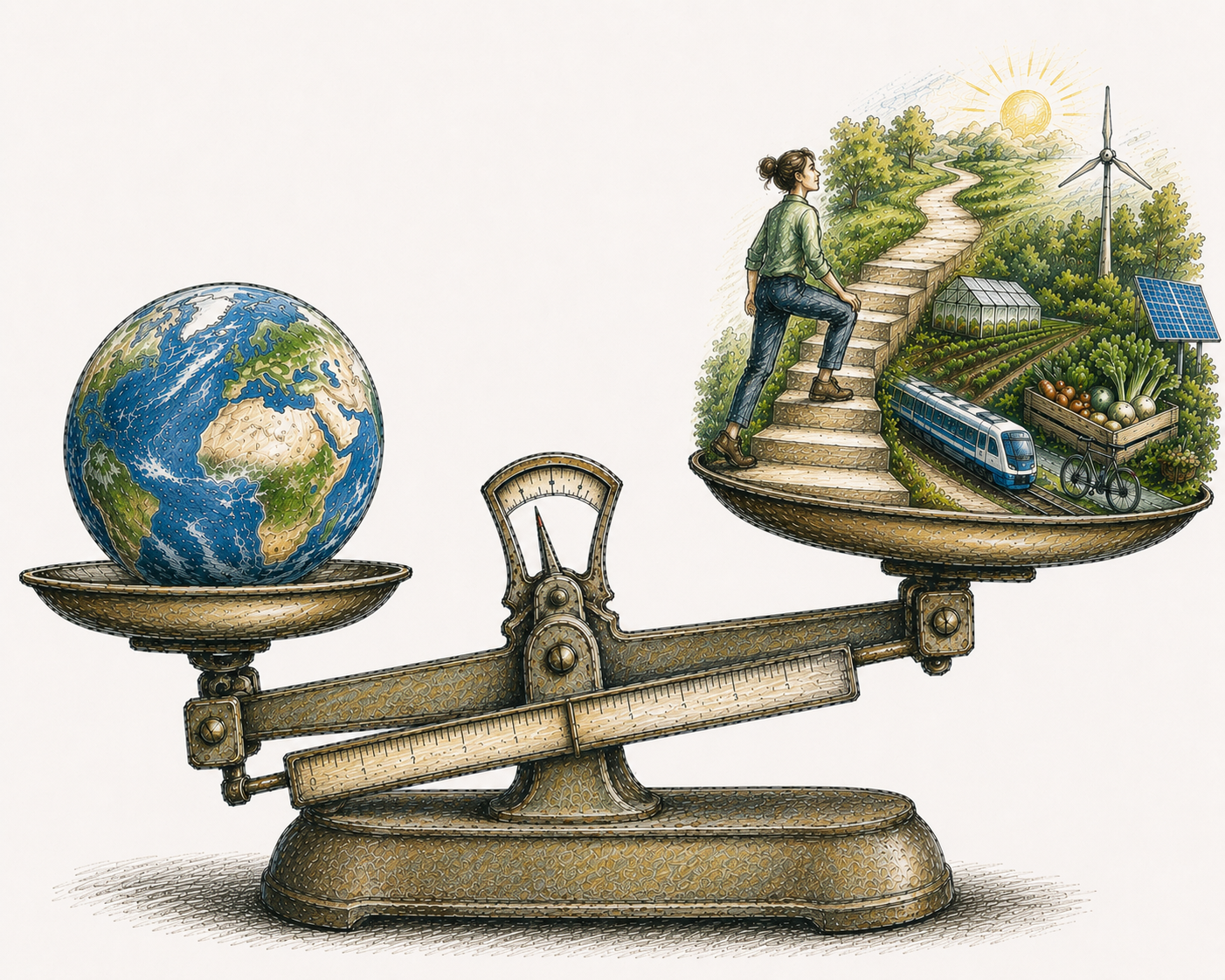
Bram: If we get our processes properly efficient, really think carefully about the energy we use, and also about "duurzame inzetbaarheid", and get that genuinely institutionalised, then you can start making real steps. Because then everyone knows where they stand and which direction we're going. And that immediately has an influence on the society around us. If we can demonstrate that we do sustainability this way, that has its effect on the families people go home to. The conversations they have with friends and colleagues. Then you get a flywheel turning. And that's actually an underestimated mechanism that can be deployed much more intentionally.
Everything I do in the OHS field, I make available to the whole of NWO-I. And from NWO-I, we sit in the SAAS Union,
the collaboration between academic hospitals and universities. If we bring our sustainability principles into that network, they can do something with them too. Then you get a real flywheel effect with actual reach. And you can also learn from it,
you can hold Nikhef up to what others are doing and cherry-pick what works for your own programme.
That's how a small institute can have an impact far beyond its own walls.