Interview Andreas
"Say no to what's stupid, say yes to what nobody else does"
A physicist on role models, ticking boxes, and why technology won't save us
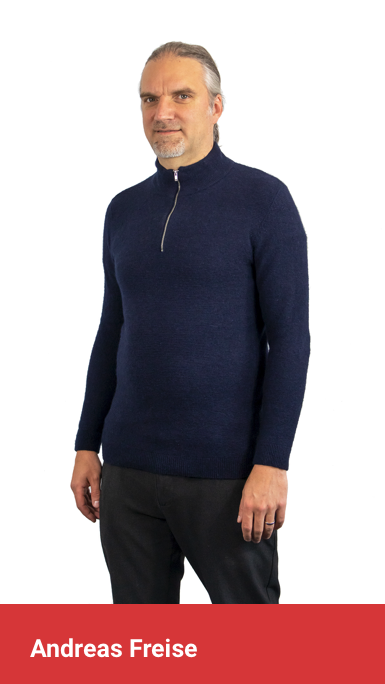
Andreas Freise has a problem with the word sustainability. Not with the idea, but with what happens to it once it lands in a grant proposal. "You get this feeling of 'I have to fake it'," he says. He pauses, then corrects himself. "Not fake it. But you know the feeling."
Freise is a professor at Nikhef working on gravitational wave detection. He thinks carefully before he speaks, and is deeply skeptical of any solution that doesn't start with changing how people think. He is also, by the end of this conversation, one of the honest voices you'll hear on what an institute like Nikhef can, and cannot, actually do.
Catharina: What does sustainability mean to you?
Andreas: Not relying on limited resources, though that's a bit of a weasel phrase, because everything is limited in some way. But if you're doing something where your core idea depends on exploiting something that will run out, or that you're harming in the process, then it's not sustainable. And not having your main idea be fundamentally limited by the fact that you're using limited resources.
For research it looks a bit different than for a private person. As a researcher, my resources are people and government funding. That's basically what I ask for, what I get, and what I use. So if I start exploiting people, if I can only do my research by harming other people's careers, or by misusing them, then I'm not sustainable as a researcher. And the same for government funding. There's a balance: value for money, to some extent. Society has to decide how much science they want to invest in, and I need to map my research to that. If I can't deliver at that level, then my research is not sustainable.
Catharina: How do you make sure the people in your group are in a sustainable environment: i.e. not burning out?
Andreas: We do this together, I think, as individuals, and in our research groups at Nikhef. It's not formalised in this exact language, but it's indirectly behind many of the rules and processes we have. The independence of the researcher/PhD student; trying to encourage teamwork rather than a top-down hierarchy. Trying to balance the needs of a project with the academic freedom of early-career researchers.
I've been told numerous times, for example, that I cannot just go to a technical group and demand a technician. That's not how it works here. I'm supposed to talk to people, make them excited about my project, and only after everyone basically wants to do it, do I go to the group leader and ask if that person can work with me for six months. That's not a written rule. But literally everyone, from the directorate to colleagues, has explained it to me the same way. I find that quite nice.
Catharina: Is that a personal touch you give to your group, or something NIkhef actually embeds?
Andreas: Both, but I'd say Nikhef has it almost structurally embedded; in the sense that you can't find the text where it's written, but the rules point in this direction. I think Nikhef does this better than many places, where it's really left to individuals. Here it's peer pressure, at least, which already goes in the right direction.
Catharina: Do you think Nikhef's research can contribute to solving the big societal challenges?
Andreas: I find it quite funny to look at that list [of challenges you provided;]. Everything on it is human-made. I'd call them human errors. And scientists are really bad with humans, I'd call them "human errors". If you think about it: we do technology. And I don't believe technology can solve these problems. I'm a firm believer that you can't "technology" your way out of climate change. This is clearly a human problem, and we are terribly bad at influencing humans as individuals.
The only chance we have is as a community (and as an institute) where we're not directly trying to influence one person, but where we can be a role model, a guiding light. And that we can sometimes do quite well. I think Nikhef and ETO are both trying to be better in that sense; actively thinking: can we be a role model? We travel less, we make different rules for ourselves. And I think that's where scientists can help. But that's it. That's really the limit of it.
Catharina: Why do you think an institution has more impact than an individual?
Andreas: Because the interface changes. As a person, it comes down to your interpersonal skills. and on average, scientists don't have those. We're not the influencer type. I am certainly worse than most at this. So we can't really influence people as individuals, not in a directed way.
But as a community, the interface is different. It's not your personal skills anymore, but how your institute acts in relation to society. And there we have real advantages. Companies can't be as transparent; they hidhave to hide things, which is not a good look. We can be transparent, we can show our inner workings, we can be honest, we can even show failure. We can be smart in one area and openly say we're not doing the other thing. Scientists and scientific institutes, either deservedly or not, are trusted in a way that companies or a political party are not. That's a platform. It's valuable. And we don't use it enough.
Catharina: Could your fundamental research — gravitational waves, quantum sensing — actually transform society?
Andreas: The research itself? No. Whatever I'm researching directly will not solve anything [related to climate]. I don't think it will matter. Detecting a gravitational wave will not fix climate change. Developing better hardware will not be enough. That's not really the point.
But what might help is promoting a different type of being human. What I do and what you can do with already with a pen and paper, is curiosity-driven. Looking for knowledge. And by saying that this is important, you move focus away from consumerism, from burning up resources. A lot of the driving force behind overconsumption is looking for wealth, for status, in a material sense. If you can show that what we do is cool and interesting, that you can get fun and meaning and status from that, without "burning things" to start your day, that's something. Being a role model in that sense. I think that helps.
Catharina: But with research, we are also consumers; we need 'stuff', we built 'stuff' to do the research, right?
Andreas: That's the most difficult question. I don't know. I think we should always do better. But your question also touches on something I find genuinely hard: is it my problem, or is it the system's fault? Does it help if I recycle glass, or should I be demanding that there's less packaging in the first place? Those discussions often look like this is a conflict, and I think it's not really a conflict, but it's still difficult for me to say where to put the energy: helping everyone improve personally, or demanding system change?
Nikhef is already more sustainable than most. That's good. But should we do more? Maybe. Should we demand more from others? Probably. I don't think the answer is to be pure; never fly, avoid AI completely, only run detectors on solar power. Being pure means making very many sacrifices, and I think that limits the research without solving the underlying problem. What we should do; and I think we're not doing enough, is contribute to the societal discussion about how we actually get out of this. Scientists should have a voice there. And we're not really using it.
Catharina: What practically can we do?
Andreas: For example, the AI question is already happening, actually, and I think we're remarkably advanced on it compared to others. We have an AI group, we're discussing how much energy goes in, what we can tolerate. And when I asked for an AI subscription, I was told: we're not paying a Silicon Valley company, sorry. In almost any other place in Amsterdam they'd have just said yes, here you go. So that's already happening.
But the broader question for me is: are we doing practically enough to have a voice? If the problem really isn't technology, and it isn't my specific research, then the question becomes: sustainability as a society, can we solve it? And do we do anything there, or do we just say it's not our problem? Because I think at the moment, the direction of scientific development is toward becoming knowledge factories. You turn the handle, you crank out knowledge, and otherwise: shut up, don't be political. And I think we do too little to push back on that. There are very few discussions about politics, economics, global dynamics happening in Nikhef or in my university where physicists and technical people are actually present. I find that something I could do better. I always think I should recommend a book at the start of a lecture, or bring up a current event, but then I never really do.
Catharina: You mentioned the word sustainability itself makes you react negatively sometimes. Why?
Andreas: Because when I have to write it in a proposal, I get this feeling of; oh, I have to perform it. And that poisons the effort of people who actually want to do something better. Because it creates a dynamic where the few people who want to genuinely do something are not being heard, and the ones who just tick the box get the attention.
I want to tell you about something that wasn't funny at all, actually, it was strange, and it annoyed me a lot. Same dynamic, but about gender balance. When we put in a proposal, we had something like 20% women in leadership positions in our group. We'd actually started pushing on this, actively working on it. But we were told in the feedback that this wasn't good enough; could we explain what we were doing about it.
One of the people on our team was a woman who had put enormous personal effort into exactly this. She'd set up support groups and made it a real part of her work. When we went back to the review panel, we got the same accusation again. And than she started to talk about everything she was doing. And then a white man cut her off and said: no, you're still not doing enough.
And I thought: this is exactly the situation I don't want to see. You're not actually helping. You're ticking a box. And you're not listening to the one person in the room who's actually putting in the work. She's only one out of ten, fine, we can admit there should be more, but somebody is actually working on it, wants to explain, and you don't let her speak.
In sustainability I see the same dynamics. The people who want to do something are not being heard. If we want to help, I think it's important to name that, to sometimes be bold and say: "this is rubbish. I like sustainability, but not this version of it." Say no to things we think are stupid. Say yes to things nobody else does.